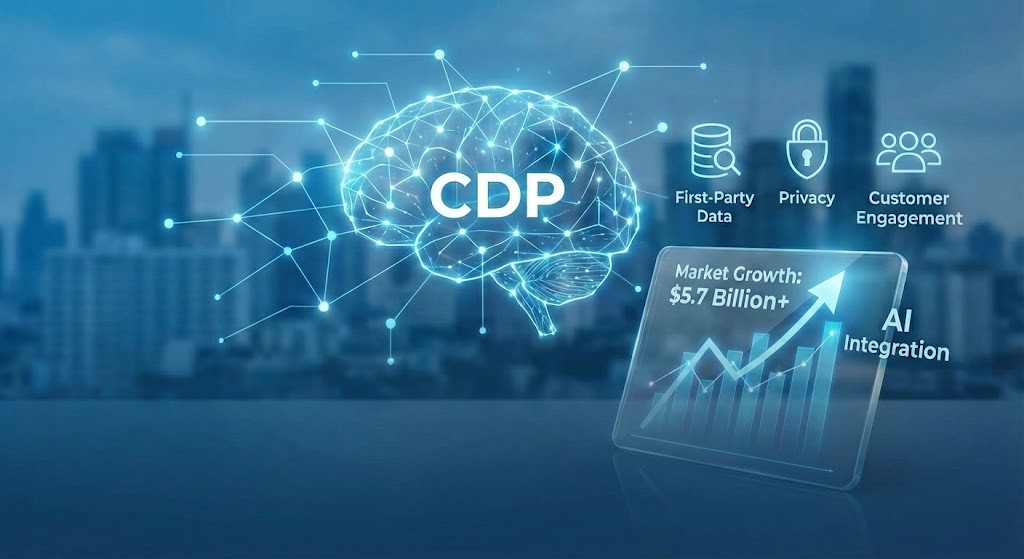
The Customer Data Platform (CDP) landscape is experiencing unprecedented transformation in 2026. As businesses navigate the complexities of first-party data, AI integration, and evolving privacy regulations, CDPs have emerged as the essential infrastructure for modern customer engagement. Here are the key trends shaping the CDP market this year.Market Growth and Economic Impact
The CDP market continues its remarkable expansion trajectory. Industry analysts project the global CDP market to surpass $5.7 billion in 2026, with some estimates reaching as high as $6.24 billion. This growth is driven by a compound annual growth rate exceeding 30% through 2030, reflecting the technology’s critical role in modern business operations.
- First-Party Data Becomes the Foundation
With the ongoing deprecation of third-party cookies and stricter consent regulations, CDPs have become indispensable for understanding customer behavior. The platform now serves as the backbone of business operations, unifying first-party data from multiple sources including websites, mobile apps, physical stores, CRM systems, marketing campaigns, and customer service interactions. This unified approach enables organizations to build comprehensive 360-degree customer profiles while maintaining data sovereignty and compliance.AI-Powered Data Activation
Artificial intelligence has become the central engine for data activation in 2026. CDPs now leverage AI to transform complex datasets into strategic, actionable insights without requiring slow or highly specialized internal processes. Machine learning capabilities enable predictive analytics for customer behavior, automated segmentation, and personalized recommendations at scale. The key differentiator is no longer the technology itself, but rather the clarity and business relevance of the use cases being addressed.
- The Rise of Composable and Modular CDPs
Modular CDPs are gaining significant traction as organizations seek more flexible implementation approaches. These platforms allow companies to activate only the components they need, reducing the learning curve, eliminating unnecessary complexity, and facilitating real adoption across teams. This approach removes traditional bottlenecks and accelerates campaign activation, making CDP technology more accessible to organizations of all sizes.Real-Time Data Processing as Standard
Real-time capability has evolved from a competitive differentiator to an operational expectation in 2026. Modern CDPs can update customer profiles, segment audiences, and activate campaigns in seconds. This real-time processing enables businesses to personalize experiences instantly, respond to interest or churn signals in the moment, and optimize resources with greater precision. The technology now turns data into immediate action, closing the loop from insight to decision to execution in one integrated flow.
- Enhanced Privacy and Compliance Features
As data privacy regulations continue to evolve globally, CDPs have significantly enhanced their security and compliance capabilities. Platforms now include sophisticated tools for GDPR compliance, data sovereignty management, and transparent consent handling. This focus on responsible data management has become essential for building customer trust and meeting regulatory requirements across different jurisdictions.Omnichannel Integration and Unified Customer Experience
CDPs in 2026 are delivering truly unified omnichannel experiences. By integrating customer data across all touchpoints—digital, physical, mobile, and social—these platforms ensure consistent customer experiences regardless of the interaction channel. This seamless integration allows businesses to maintain context across customer journeys and deliver personalized engagement at every touchpoint.
Looking Ahead
The CDP market’s transformation in 2026 reflects broader shifts in how organizations approach customer engagement. As first-party data becomes increasingly valuable, AI capabilities mature, and privacy regulations tighten, CDPs have evolved from nice-to-have marketing tools into mission-critical business infrastructure. Organizations that successfully leverage these platforms are better positioned to build meaningful customer relationships, drive personalization at scale, and navigate the complex data landscape of modern business.
For businesses evaluating CDP solutions, the focus should be on platforms that offer flexibility, strong AI capabilities, real-time processing, and robust privacy features—all while maintaining the ability to scale with organizational needs and adapt to evolving market conditions.