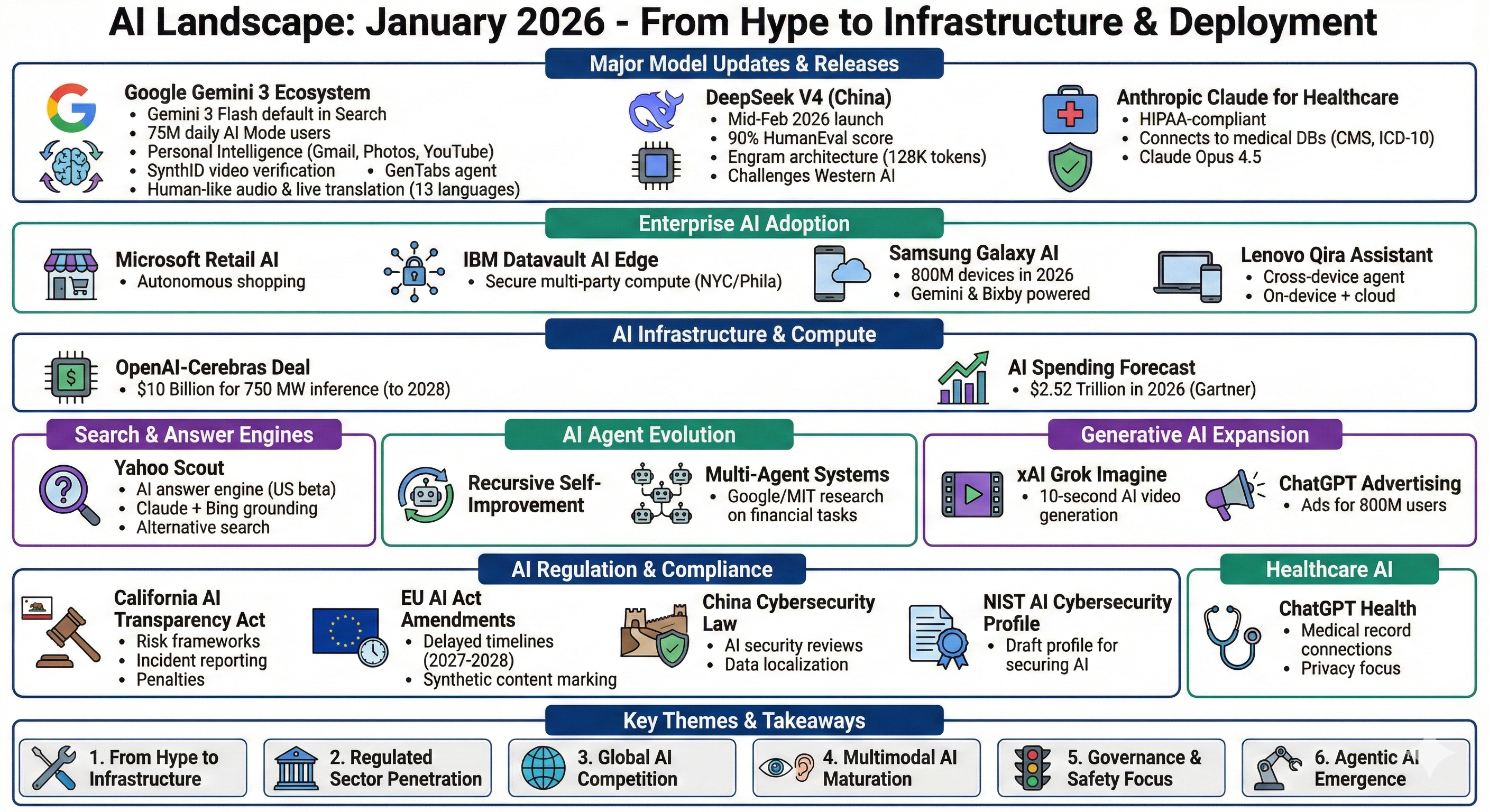
January 2026 marked a significant shift in the AI landscape, moving from experimentation to real-world deployment and infrastructure. Here’s a comprehensive summary of the major AI developments and their impact:
Major Model Updates & Releases
Google Gemini 3 Ecosystem Expansion
Google rolled out Gemini 3 Flash as the default model for Google Search globally
Introduced AI Mode with 75 million daily active users across 40 languages
Launched Personal Intelligence feature that connects across Gmail, Photos, Search history, and YouTube for deeply personalized assistance
Added SynthID video verification to mark AI-generated content
Introduced GenTabs (Disco) – an AI browser agent that synthesizes information from open tabs
Upgraded audio models with human-like text-to-speech and live translation supporting 13 languages
Impact: Transforms search from click-based to conversational, embedding AI directly into daily workflows and positioning Google as a leader in multimodal AI deployment.
DeepSeek V4 Announcement
Chinese AI startup DeepSeek announced V4 model launch for mid-February 2026
Features advanced coding capabilities with 90% HumanEval score
Powered by new “Engram” architecture processing up to 128K tokens
Internal tests show potential to outperform Claude 3.5 and GPT-4o in complex programming tasks
Impact: Challenges Western AI dominance and demonstrates China’s rapid advancement in cost-effective AI development, intensifying global AI competition.
Anthropic Claude for Healthcare
Introduced HIPAA-compliant Claude for Healthcare and Life Sciences
Enables connection to medical databases (CMS, ICD-10, NPI registries)
Built on Claude Opus 4.5 with improved long-context reasoning
Impact: Opens regulated healthcare and life sciences sectors to AI deployment, signaling maturity of AI systems for sensitive enterprise applications.
OpenAI Model Transitions
Announced retirement of GPT-4o, GPT-4.1, GPT-4.1 mini, and OpenAI o4-mini on February 13, 2026
Released GPT-5.2 with improved personality system and conversational capabilities
Enabled more models for GPTs with custom actions (GPT-5.2 Instant and Thinking)
Improved search response quality in Voice mode
Made responses more visual with at-a-glance highlights and side panels
Impact: Signals shift to newer, more capable models while sunsetting legacy systems, pushing users toward more advanced AI capabilities.
Enterprise AI Adoption
Microsoft Retail AI Tools
Rolled out AI assistants for retail that plan, recommend, and transact
Impact: Direct integration of AI into e-commerce workflows, enabling autonomous shopping experiences.
IBM Datavault AI Edge Deployment
Partnership to deploy AI at edge locations across SanQtum network (NYC/Philadelphia)
Uses IBM’s watsonx.ai with secure multi-party compute
Focuses on cybersecurity and analytics with privacy safeguards
Impact: Addresses enterprise need for AI deployment close to data sources in regulated environments.
Samsung Galaxy AI Expansion
Plans to double AI-enabled devices to 800 million in 2026 (from 400 million)
Powered by Google Gemini and Bixby models
Features include translation, note-taking, and generative photo editing
Impact: Massive scale deployment of AI in consumer hardware, increasing AI accessibility and semiconductor demand.
Lenovo Qira Cross-Device Assistant
Unveiled at CES 2026 for Lenovo laptops and Motorola phones
Uses blend of on-device models and cloud services (OpenAI, Microsoft Azure, Stability AI)
Features optional memory with visible privacy controls
Enables seamless task movement between devices
Impact: Demonstrates evolution toward context-aware agentic systems that work across platforms.
AI Infrastructure & Compute
OpenAI-Cerebras $10 Billion Deal
Three-year agreement for 750 MW of inference compute
Powered by Cerebras wafer-scale chips through 2028
Impact: Highlights massive capital intensity of AI infrastructure and growing importance of specialized hardware for faster inference.
AI Spending Forecast
Worldwide AI spending forecast to reach $2.52 trillion in 2026 (44% YoY increase per Gartner)
Impact: Confirms AI transition from experimentation to core enterprise infrastructure investment.
Search & Answer Engines
Yahoo Scout Launch
AI-powered answer engine in US beta
Uses Claude as primary model with Bing grounding API
Leverages hundreds of millions of user profiles and entity knowledge graph
Covers shopping comparisons, stock analysis, weather, and fact-checking
Impact: Intensifies competition in AI-powered search market, positioning Yahoo as alternative to Google and ChatGPT.
AI Agent Evolution
Recursive Self-Improvement Research
Leading AI labs exploring models that refine themselves post-deployment
Impact: Potential to accelerate AI development but introduces harder-to-detect risks and governance challenges.
Multi-Agent System Research
Google and MIT found multi-agent systems improve financial tasks but degrade sequential workflows
Performance often drops once single agent reaches 45% success rate
Impact: Provides critical insights into when and how to deploy multi-agent systems effectively.
Generative AI Expansion
xAI Grok Imagine Video Generation
Expanded to generate 10-second AI videos
Extends multimodal capabilities beyond images
Impact: Intensifies competition in generative video market, making realistic synthetic content easier to produce at scale.
ChatGPT Advertising
800 million ChatGPT users set to see ads
Impact: Signals monetization shift for AI assistants, potentially changing user experience dynamics.
E-Commerce AI Impact
AI-Driven Traffic Surge
US e-commerce sites saw 758% YoY increase in AI-driven traffic (November 2025)
Cyber Monday experienced 670% increase in AI-referred traffic
Impact: Demonstrates AI’s transformative effect on online shopping behavior and discovery patterns.
AI Regulation & Compliance
California AI Transparency Act (SB 53)
Effective January 1, 2026
Requires developers of large AI models (>10²⁶ FLOPS) to:
Publish risk frameworks
Report critical safety incidents within 15 days
Implement whistleblower protections
Penalties up to $1 million per violation
Impact: Sets precedent for state-level AI governance in absence of federal regulation.
EU AI Act Amendments
Proposed delays to implementation timelines:
GPAI providers: August 2027 (from February 2027)
High-risk systems: August 2028 (from August 2027)
Synthetic content marking: February 2027
AI literacy obligation (Article 4) proposed for abolition
Special category data processing allowed for bias detection
Wider exemptions from reporting obligations
Impact: Provides organizations more time for compliance while maintaining safety standards.
China Cybersecurity Law
Amended law became enforceable January 1, 2026
Adds AI security reviews and data localization requirements
Impact: Creates distinct AI governance framework in China, potentially fragmenting global AI ecosystem.
NIST AI Cybersecurity Profile
Published draft profile for AI cybersecurity
Covers securing AI systems, defensive AI use, and countering AI-enabled threats
Workshop held January 14, 2026
Impact: Provides template for enterprises to integrate AI into cybersecurity governance frameworks.
Healthcare AI
ChatGPT Health Launch
Dedicated health experience allowing medical record and wellness app connections
Encrypted conversations not used for training
Impact: Signals AI expansion into sensitive healthcare domain with emphasis on privacy.
Key Themes & Takeaways
1. From Hype to Infrastructure
AI shifting from experimentation to everyday business infrastructure
Execution matters more than novelty
Impact: Organizations must focus on practical deployment and ROI rather than proof-of-concepts.
2. Regulated Sector Penetration
Healthcare, finance, and government increasingly adopting AI
Compliance-ready solutions emerging
Impact: AI becoming mission-critical in previously cautious sectors.
3. Global AI Competition
DeepSeek and Chinese AI firms challenging Western dominance
Technology nationalism influencing development
Impact: Potential fragmentation of AI ecosystem along geopolitical lines.
4. Multimodal AI Maturation
Video, audio, and cross-modal capabilities advancing rapidly
Integration across devices and platforms
Impact: User expectations rising for seamless, context-aware AI experiences.
5. Governance & Safety Focus
State and international regulations taking shape
Emphasis on transparency, safety incidents, and synthetic content marking
Impact: Compliance becoming central to AI strategy; early adopters of governance frameworks gain competitive advantage.
6. Agentic AI Emergence
Systems that plan, act, and improve autonomously
Cross-device and cross-platform coordination
Impact: Next phase of AI will be about autonomous task completion, not just information retrieval.
Conclusion
January 2026 demonstrated that AI has moved decisively from research labs into production environments across industries. The convergence of powerful models, enterprise readiness, regulatory frameworks, and massive infrastructure investments signals that 2026 will be the year AI becomes truly embedded in business operations. Organizations must now focus on strategic deployment, governance, and measuring real business impact rather than exploring AI’s potential.