Physical Address
304 North Cardinal St.
Dorchester Center, MA 02124
Physical Address
304 North Cardinal St.
Dorchester Center, MA 02124

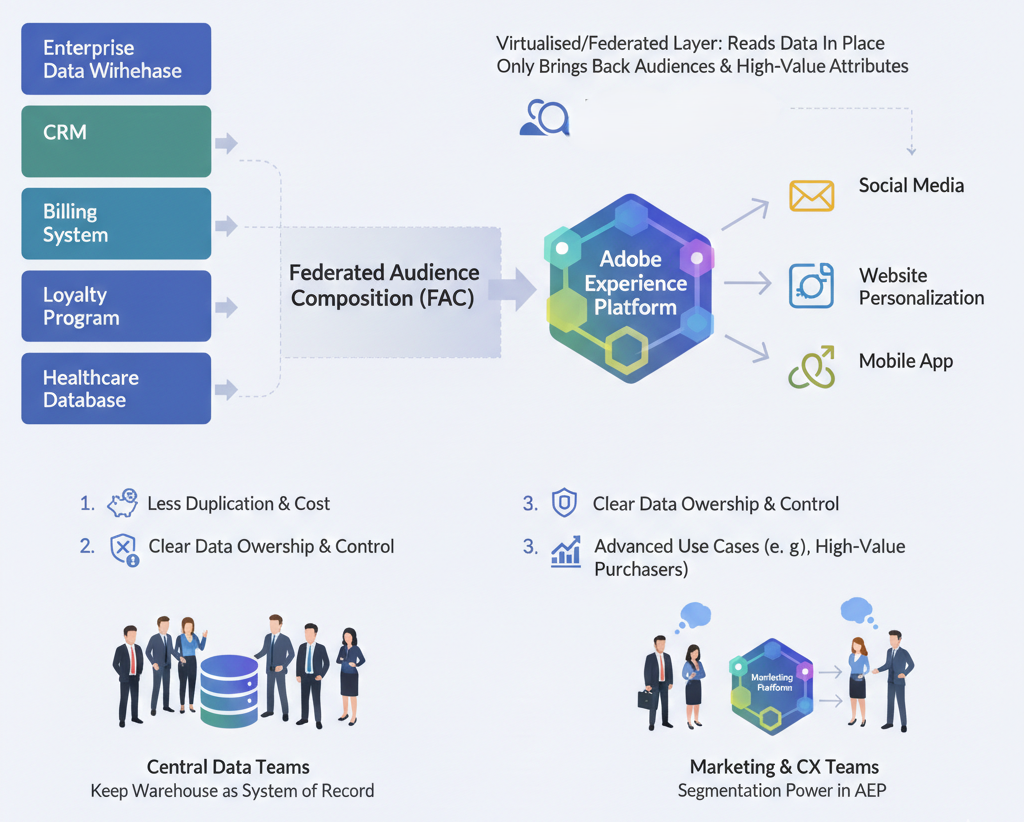
Federated Audience Composition (FAC) is Adobe’s way of letting you treat your enterprise data warehouse as an extension of Adobe Experience Platform (AEP) for audience building—without copying all that raw data into AEP.
FAC lets you connect AEP to external systems of record (enterprise data warehouses, CRM, billing, loyalty, healthcare, etc.) and build audiences on top of those datasets as if they lived inside AEP. Instead of ingesting every transaction or operational record, AEP uses a virtualized/federated layer that reads the data in place and only brings back the resulting audiences and high‑value attributes.
With this approach, you can:
Use marketer‑friendly visual compositions to build and enrich audiences across multiple warehouse tables and AEP datasets.
Why FAC matters for enterprises
For large enterprises, customer data is fragmented across many systems of record and massive cloud data warehouses. FAC gives you a governed way to tap that investment without turning AEP into yet another copy of your data warehouse.
Key enterprise benefits:
In short, FAC lets central data teams keep their warehouse as the system of record, while marketing and CX teams get the segmentation power they need in AEP.
The core tradeoff: batch vs real time
FAC audiences are evaluated using batch segmentation, typically on a daily schedule for large‑scale implementations. That means there is an inherent delay between a qualifying event (like a purchase or coupon redemption stored in the warehouse) and the next audience refresh in AEP.
Implications:
That’s why smart teams treat FAC as the backbone for who is eligible, and then layer real‑time capabilities for what happens right now.
How to bridge FAC with real-time decisions
To avoid waiting for the next batch when a customer acts, enterprises combine FAC with real‑time features in AEP and Adobe Journey Optimizer (AJO).
Typical patterns include:
The operating model: FAC sets the universe of who can be targeted, while real‑time profile events, attributes, and journey logic determine whether they should be targeted right now.
Example enterprise scenario: coupon redemption at scale
Consider a retailer with:
A scalable setup could look like this:
The customer may technically remain in the FAC “High-Value Coupon Eligible” audience until the nightly batch re‑evaluation runs, but decision-time logic ensures they do not receive duplicate coupons or conflicting messages in the meantime.
Conclusion: using FAC as the backbone of scalable personalization
In modern enterprise architectures, FAC is a structural capability, not just another segmentation feature. It lets organizations centralize data in their warehouse, minimize duplication, and still put rich, cross‑system attributes in the hands of marketers through AEP.
The winning pattern is to let FAC define who is structurally eligible based on deep, often regulated systems of record—then use real‑time profile updates, decision rules, and journeys to govern what happens next in the moments that actually matter. That is how you scale personalization without fighting the inherent latency of batch audience evaluation.n actually is
Minimize data movement and duplication by avoiding bulk copies of sensitive warehouse data into AEP.
Curate both ingested audiences and federated audiences in a single experience-driven workflow within Real-Time CDP and Journey Optimizer.