Physical Address
304 North Cardinal St.
Dorchester Center, MA 02124
Physical Address
304 North Cardinal St.
Dorchester Center, MA 02124

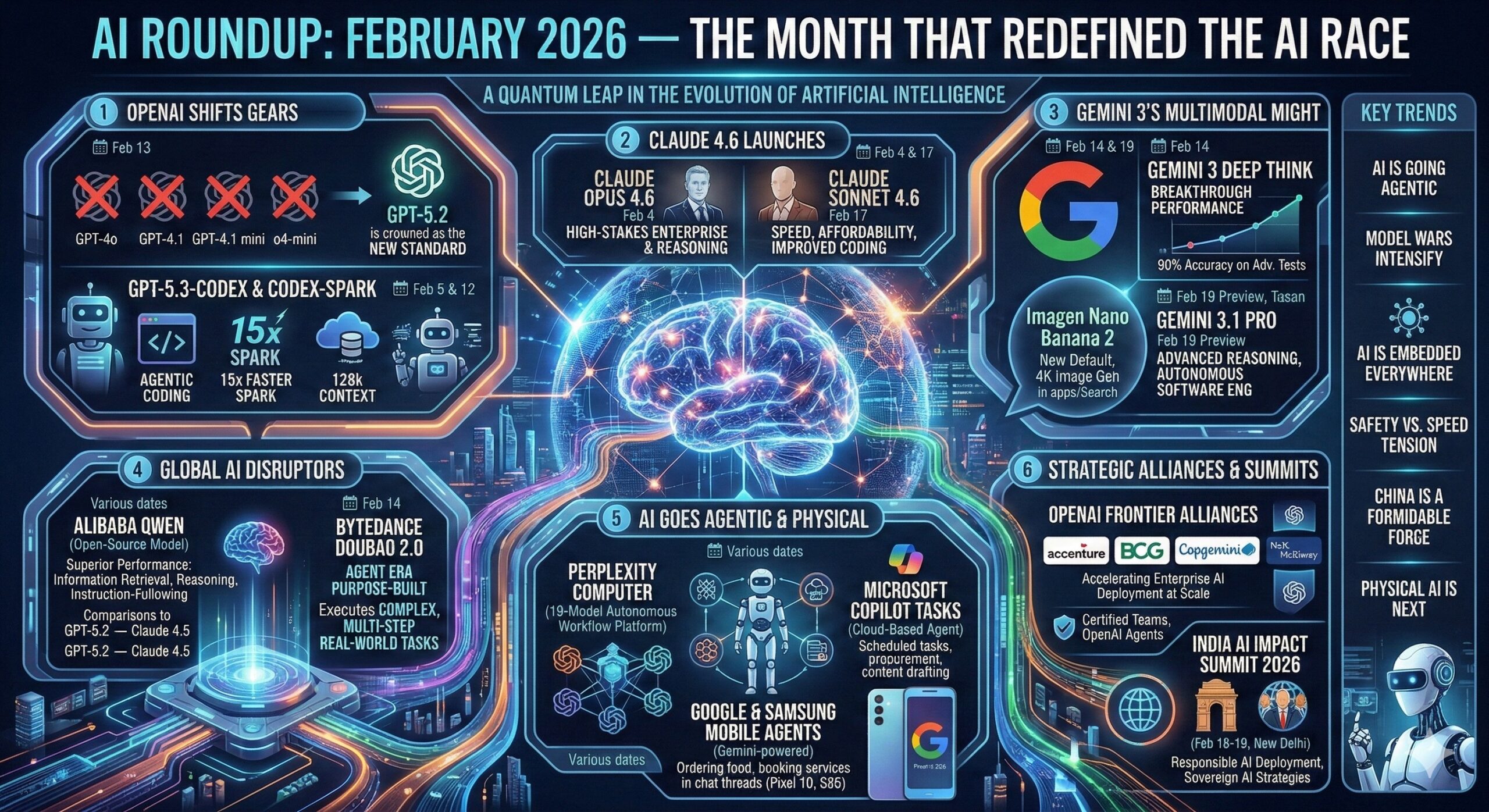
February 2026 proved to be one of the most action-packed months in AI history. From model launches and safety policy shifts to agentic AI platforms and enterprise alliances, the pace of development accelerated significantly. Here is a comprehensive roundup of all the key AI developments from February 2026, along with their broader implications.
On February 13, 2026, OpenAI officially retired GPT-4o along with GPT-4.1, GPT-4.1 mini, and o4-mini. GPT-5.2 became the new default model for creative writing, conversational tasks, and professional workflows. The API transition gave developers a three-month window to migrate.
Impact: This marks the end of an era for millions of users who relied on GPT-4o for its warmth and personality. With GPT-5.2 now the standard, businesses and developers must adapt their prompts, integrations, and workflows. The move also signals that OpenAI is accelerating its model lifecycle, pushing the industry toward faster adoption of next-gen AI.
On February 5, OpenAI introduced GPT-5.3-Codex, its most capable agentic coding model to date. This was followed on February 12 with GPT-5.3-Codex-Spark, a real-time coding model offering 15x faster generation speeds and a 128k context window, initially available as a research preview for ChatGPT Pro users.
Impact: These releases significantly elevate AI-assisted software development. For developers, the combination of agentic coding and real-time responsiveness means AI can now handle complex multi-file coding projects with speed and accuracy. Enterprises building on top of OpenAI’s platform gain a powerful competitive edge in software delivery.
Anthropic released Claude Opus 4.6 on February 4 and Claude Sonnet 4.6 on February 17. The Sonnet variant focuses on speed, affordability, and improved coding performance, while Opus 4.6 targets complex reasoning and high-stakes enterprise tasks. These were positioned as direct competitors to OpenAI’s GPT-5 series.
Impact: Anthropic continues to push the frontier on safe and performant models. The Sonnet variant’s cost-efficiency makes advanced AI accessible to startups and mid-market companies. The dual-model strategy — power vs. speed — mirrors OpenAI’s own tiered approach and gives enterprises more flexibility in model selection.
Google DeepMind released Gemini 3 Deep Think on February 14, delivering breakthrough performance on complex scientific, mathematical, and engineering benchmarks (up to 90% accuracy on advanced tests). It also previewed Gemini 3.1 Pro on February 19, focused on advanced reasoning and autonomous software engineering tasks. Imagen Nano Banana 2 (a fast, high-fidelity image generation model supporting up to 4K resolution) was also released as the new default across Gemini app, Google Lens, AI Mode in Search, and Google Flow.
Impact: Google is making a strong case for multimodal AI supremacy. Gemini 3.1 Pro’s reasoning capabilities position it as a genuine competitor to OpenAI and Anthropic for enterprise use cases. Nano Banana 2’s deployment across Google’s product ecosystem means billions of users will experience higher-quality AI-generated images in everyday tools.
Google relaunched its AI creative studio Flow, integrating tools like Whisk and ImageFX, and centering workflows around Nano Banana and Veo models. New capabilities included targeted image editing with lasso controls, clip extension, camera movement adjustments, and flexible media collections. Users have generated over 1.5 billion assets since the platform’s launch.
Impact: Flow represents Google’s direct challenge to Adobe and other creative platforms. By unifying text, image, and video creation under one AI-native roof, Google is democratizing content production. For marketers, filmmakers, and content creators, this means significantly reduced production timelines and costs — though it also raises questions about creative originality and copyright.
Chinese tech giant Alibaba released Qwen, a new open-source generative AI model that quickly earned comparisons to and praise over GPT-5.2 and Claude 4.5. The model demonstrated superior performance in information retrieval, reasoning, and instruction-following tasks. Experts noted it competes not just on performance but also on cost, making it a significant disruptor in the global AI market.
Impact: Qwen reinforces the growing strength of Chinese AI development. For global enterprises, it opens up a powerful and cost-effective alternative to Western models. The open-source nature further accelerates adoption and customization. Regulators and policymakers in the US and EU are expected to scrutinize its deployment as concerns around data sovereignty and AI governance intensify.
ByteDance upgraded Doubao — China’s most popular AI chatbot — to version 2.0 on February 14. The new model is purpose-built for the “agent era,” capable of executing complex, multi-step real-world tasks with enhanced reasoning and autonomous planning. It moves beyond conventional chat interaction into full task execution.
Impact: Doubao 2.0 signals that agentic AI is no longer just a Western tech narrative. With ByteDance’s massive user base across Asia, this rollout could rapidly mainstream agentic AI for hundreds of millions of users. Businesses can expect faster automation of customer support, research, and operational tasks through agent-based AI systems.
Seedance 2.0, a text-to-video and image-to-video model, made waves in February 2026 after going viral online for generating highly realistic video clips from simple prompts. The model significantly reduces the time and cost of video production, drawing attention from marketers, filmmakers, and content creators worldwide.
Impact: Generative video is now entering the mainstream. Seedance 2.0’s viral moment underscores the rapid maturation of AI video technology. This has massive implications for media, advertising, and entertainment industries. However, its ease of use has also intensified conversations around deepfakes, misinformation, and the need for content authentication standards like C2PA watermarking.
OpenAI announced multi-year “Frontier Alliance” partnerships with Accenture, Boston Consulting Group, Capgemini, and McKinsey. These alliances are designed to accelerate enterprise AI deployment at scale, with consulting firms embedding certified teams to integrate OpenAI agents into real production workflows. Enterprise revenue already represents a substantial portion of OpenAI’s business.
Impact: This is a pivotal moment for enterprise AI adoption. Businesses can now access structured AI transformation programs backed by world-class consulting expertise. For CIOs and IT leaders, this reduces the risk and complexity of deploying AI agents in production. It also validates the shift from experimental AI pilots to mission-critical operational deployments.
Perplexity introduced Perplexity Computer, an ambitious platform that orchestrates 19 specialized AI models to execute complex workflows that can run for hours or even months. Unlike single-model chat systems, it breaks objectives into subtasks, spins up sub-agents, integrates APIs, accesses real file systems, and coordinates asynchronous execution. It is purpose-built for long-running autonomous workflows.
Impact: Perplexity is evolving from a search tool to a full-fledged autonomous AI operating system. This positions it as a serious contender in the AI agent platform space alongside OpenAI and Anthropic. For businesses, this signals the dawn of truly autonomous AI workers that can handle end-to-end processes without human handholding.
Microsoft unveiled Copilot Tasks, an AI system that operates on a Cloud-hosted computer to complete recurring or one-time user assignments autonomously. Users describe objectives in natural language and the system handles scheduling, subscription management, monitoring listings, and content drafting while running in the background. It requests approval before taking significant actions.
Impact: Microsoft is positioning Copilot as a persistent, always-on AI employee rather than just a chat assistant. This is a major shift for enterprise productivity. Organizations can delegate recurring tasks — from procurement monitoring to report generation — to AI agents, dramatically reducing manual effort and freeing human workers for higher-value activities.
Google announced Gemini-powered agentic features for Pixel 10 and Samsung Galaxy S26 devices, enabling users to complete complex multistep tasks — like ordering food or booking services — directly from chat threads. Gemini can analyze group conversations, determine preferences, navigate delivery platforms, and prepare orders for user approval, all autonomously.
Impact: This moves mobile AI from assistant to executor. By embedding transactional intelligence at the OS level, Google and Samsung are positioning smartphones as active AI agents rather than passive information tools. This also puts pressure on Apple, which previewed similar Siri capabilities in 2024 but has since delayed their rollout.
Both Anthropic and OpenAI made notable changes to their safety-related public commitments in February 2026. Anthropic removed a pledge to halt model training in the absence of guaranteed safeguards, emphasizing transparency measures instead. OpenAI had previously modified its mission language following structural changes. Both actions reflect the intensifying competitive and political pressures within the AI industry.
Impact: These revisions send a chilling signal to AI safety advocates. As the global AI race accelerates, leading labs appear unwilling to unilaterally slow development even as risks mount. This raises urgent questions for regulators, ethicists, and enterprise AI adopters about the long-term governance framework for powerful AI systems.
Alphabet announced that its robotics software firm Intrinsic will operate more closely within Google, collaborating directly with Google DeepMind and leveraging Gemini models and Cloud infrastructure. Intrinsic focuses on simplifying industrial robotics and previously spun out of Alphabet’s X division. The closer integration marks Google’s growing commitment to physical AI and intelligent factory automation.
Impact: This signals that the AI revolution is moving from digital to physical. Combining Gemini’s intelligence with Intrinsic’s robotics software could dramatically accelerate industrial automation and smart manufacturing. For enterprises in logistics, manufacturing, and supply chain, this opens the door to more intelligent, adaptive robotic systems that can learn and self-optimize.
New Delhi hosted the India AI Impact Summit 2026 on February 18–19, bringing together global AI industry leaders, policymakers, researchers, and governments. The summit focused on responsible AI deployment, sovereign AI strategies, and leveraging AI for social and economic development. A formal summit declaration was issued outlining key commitments.
Impact: India is asserting itself as a serious player in global AI governance. The summit reinforces India’s ambition to become a leader in AI policy and infrastructure — not just a consumer of Western AI products. For the Indian tech ecosystem, this creates opportunities around localized AI models, data governance, and AI-for-good initiatives.
February 2026 was not just a month of product releases — it was a turning point. AI is no longer a technology story; it is now a macro story reshaping industries, geopolitics, workforce dynamics, and the very nature of human productivity. Stay tuned for our monthly AI roundups as the pace of change only continues to accelerate.